
Have you ever noticed how the Gottman 4 Horsemen can appear in your relationship before you even realize what is happening?
As a Certified Gottman 7 Principles Leader and a coach who has walked alongside countless women navigating difficult relationships, I have seen these four destructive communication patterns quietly erode love, trust, and connection. And I have also seen something even more powerful: women learning to recognize these patterns, stop them in their tracks, and rebuild the peace they deserve.
Dr. John Gottman’s research at the University of Washington is nothing short of remarkable. He and his team observed couples for decades and discovered that they could predict divorce with over 90% accuracy simply by watching how couples argued.
The predictors were not the big blowups or the dramatic fights. They were four specific behaviors that Gottman named after the biblical Four Horsemen of the Apocalypse: Criticism, Contempt, Defensiveness, and Stonewalling.
Book A Pro Bono Discovery CallIf you are currently in a season of midlife awakening and wondering why your relationship feels harder than it used to, you are not alone. Many of the women I work with at Threshold Las Vegas come to me feeling frustrated, unheard, and exhausted. They sense something is wrong but cannot name it. Once they learn about the Gottman 4 Horsemen, everything clicks. Suddenly they have language for what has been happening. And more importantly, they have a path forward.
In this post, I will walk you through each of the four horsemen, what they look like in real life, why they are so damaging, and most importantly, the antidote that can stop each one. Whether you are hoping to save your marriage or simply want to communicate more consciously, this is for you.
What Are the Gottman 4 Horsemen? A Short Answer
The Gottman 4 Horsemen are four communication patterns that Dr. John Gottman identified as predictors of relationship breakdown: Criticism (attacking a partner’s character), Contempt (attacking with superiority and disrespect), Defensiveness (playing the victim and deflecting blame), and Stonewalling (shutting down and withdrawing). These patterns are not just bad habits. They are scientifically linked to divorce. The good news is that each horseman has a proven antidote. This applies to any romantic relationship, and it is relevant whether you are married, dating, or navigating a separation.
An Overview: Why These Four Patterns Matter So Much
When I first encountered the Gottman 4 Horsemen during my certification training, I felt a wave of recognition wash over me. I had seen these patterns in my own relationships and in the relationships of women I was coaching. What made Gottman’s research so powerful was that it was not theoretical. It was observational, measurable, and repeatable. Couples who displayed these patterns were significantly more likely to separate or divorce. Couples who learned to replace these patterns with healthier communication were far more likely to thrive.
The four horsemen often show up in a predictable sequence. A conversation starts with criticism, which leads to contempt, which triggers defensiveness, and finally one partner stonewalls. By the time the stonewalling happens, the connection is already badly damaged. Recognizing the horsemen early gives you the chance to stop the cycle before it escalates. And the antidotes are not complicated. They simply require practice, awareness, and a willingness to try something different.
If you are ready to go deeper, I also invite you to explore my upcoming wellness retreat where we work on relationship patterns and personal growth in a supportive, transformative setting.
Horseman 1: Criticism and Its Antidote, Gentle Start Up
Criticism is the first horseman, and it often enters a relationship so quietly that you may not even notice it at first. Criticism is different from a complaint. A complaint addresses a specific behavior: “I was worried when you did not call to say you would be late.” Criticism attacks the person’s character: “You are so thoughtless. You never consider anyone but yourself.”
When criticism becomes a regular part of how you communicate, it creates a toxic environment where your partner feels judged, defensive, and unloved. Over time, criticism erodes the emotional bank account of the relationship. Each critical comment is a withdrawal, and eventually the account runs dry.
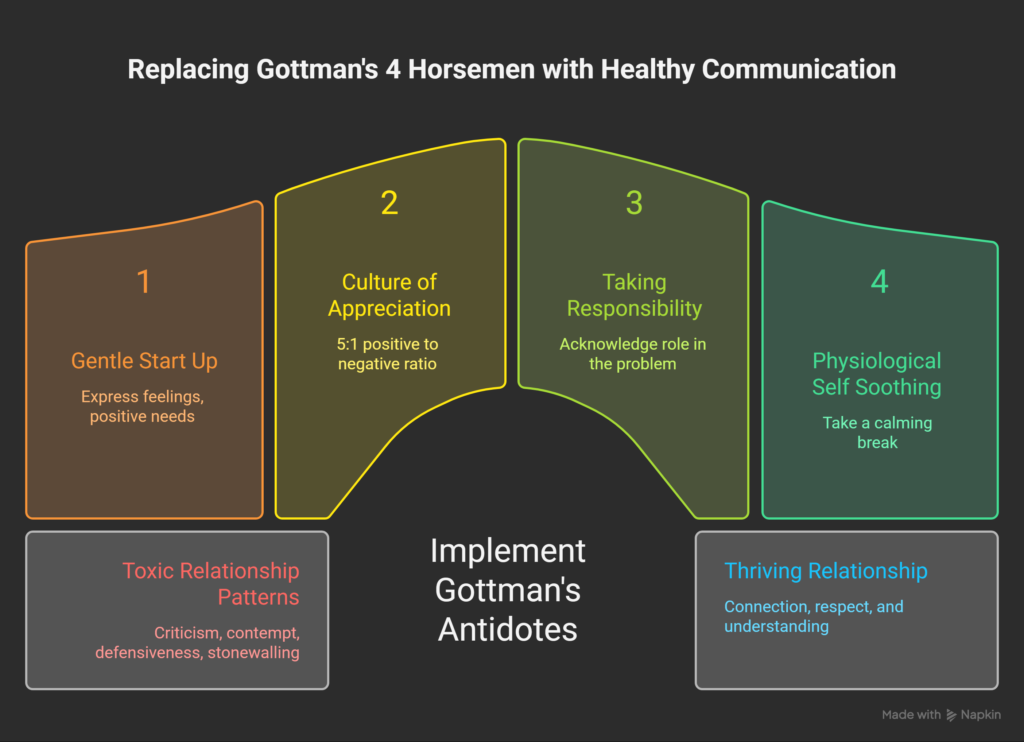
The antidote to criticism is something Gottman calls Gentle Start Up. Instead of leading with blame, you lead with your feelings and a positive need. You use “I” statements and describe what you need without attacking. For example: “I felt lonely when you came home late. I would love for us to have dinner together at least three nights a week.” This small shift in language can transform the entire tone of a conversation. It invites connection instead of conflict.
Horseman 2: Contempt and Its Antidote, Building a Culture of Appreciation
Contempt is the most dangerous of the Gottman 4 Horsemen. Dr. Gottman calls it the single best predictor of divorce. Contempt is any statement that comes from a position of superiority. It includes name calling, eye rolling, mockery, sarcasm, hostile humor, and sneering. While criticism says “you are wrong,” contempt says “you are beneath me.”
Contempt is poisonous because it conveys disgust. And when a partner feels disgusted by their spouse, the relationship is in serious trouble. Contempt often stems from pent up negative thoughts about a partner that have built up over time. The good news is that the antidote is beautiful and simple: build a culture of appreciation and respect.
Gottman’s research shows that couples who maintain a 5:1 ratio of positive to negative interactions are far more likely to stay happily married. That means for every critical or negative exchange, you need five positive ones to keep the relationship in balance. You can build appreciation by expressing genuine gratitude, noticing what your partner does right, and reminding yourself of their positive qualities. A simple practice is to say one thing you appreciate about your partner every single day. It rewires your attention toward what is working.
Horseman 3: Defensiveness and Its Antidote, Taking Responsibility
Defensiveness is almost always a response to criticism or contempt. When you feel attacked, it is natural to want to defend yourself. But defensiveness is problematic because it escalates the conflict. It sends the message “the problem is you, not me.” Common examples include making excuses, cross complaining, or playing the victim: “I would not have been late if you had reminded me.”
Defensiveness never resolves a disagreement. It simply fuels the fire. Even if you feel you are right, defensiveness prevents your partner from feeling heard. And when a partner does not feel heard, they escalate their efforts to be understood, which only makes things worse.
The antidote to defensiveness is taking responsibility, even if only for a small part of the problem. You do not have to accept all the blame. You simply have to acknowledge your role. For example: “You are right. I should have communicated better. Let me try again.” This disarms the conflict and opens the door to real dialogue. Taking responsibility is not a sign of weakness. It is a sign of strength, maturity, and love.
Horseman 4: Stonewalling and Its Antidote, Physiological Self Soothing
Stonewalling is what happens when one partner completely withdraws from the conversation. They stop responding, look away, cross their arms, or leave the room. Stonewalling is not a sign that someone does not care. It is actually a physiological response to feeling overwhelmed. When your heart rate rises above 100 beats per minute, your body releases stress hormones, and your ability to process information drops significantly. You literally cannot have a productive conversation in that state.
The antidote to stonewalling is physiological self soothing. This means taking a break from the conversation, but not a silent withdrawal. You tell your partner: “I am feeling flooded right now. I need 20 minutes to calm down, and then I want to come back and talk.” During the break, do not rehearse your argument. Instead, do something genuinely calming: go for a walk, listen to music, breathe deeply, or stretch. After 20 minutes, your body will return to a calmer state, and you can reengage with a clearer mind.
Stonewalling is often the final stage in the four horsemen cycle. If you notice yourself or your partner stonewalling regularly, it is a sign that the earlier patterns need attention. The earlier you stop the cycle, the less likely stonewalling becomes.
Frequently Asked Questions About the Gottman 4 Horsemen
Q1: What are the Gottman 4 Horsemen?
The Gottman 4 Horsemen are four negative communication patterns identified by Dr. John Gottman: Criticism, Contempt, Defensiveness, and Stonewalling. These behaviors are scientifically linked to relationship dissatisfaction and divorce. Each one has a specific antidote that can help couples rebuild connection.
Q2: Which horseman is the most dangerous?
Contempt is the most dangerous of the four. Dr. Gottman’s research shows that contempt is the single strongest predictor of divorce. Contempt includes behaviors like name calling, eye rolling, mockery, and hostile sarcasm. It conveys disgust, which is extremely damaging to emotional intimacy.
Q3: Can the 4 Horsemen be stopped?
Absolutely. Each horseman has a proven antidote. Criticism can be replaced with Gentle Start Up. Contempt can be replaced with a culture of appreciation and respect. Defensiveness can be replaced with taking responsibility. Stonewalling can be addressed through physiological self soothing. With awareness and practice, couples can break these patterns and restore healthy communication.
Q4: What is the antidote to each horseman?
The antidotes are: Gentle Start Up for Criticism, Building a Culture of Appreciation for Contempt, Taking Responsibility for Defensiveness, and Physiological Self Soothing for Stonewalling. These antidotes are practical, research backed, and accessible to anyone willing to practice them.
I have walked this path myself. Learning about the Gottman 4 Horsemen changed how I show up in my own relationships and how I support the women I coach. When you can name what is happening, you can begin to change it. You do not have to stay stuck in patterns that leave you feeling lonely, frustrated, or disconnected. There is another way, and it starts with one conversation, one antidote, and one step forward at a time.
If you would like to go even deeper, I highly recommend picking up a copy of Seven Principles for Making Marriage Work by Dr. John Gottman. This book is the foundation of much of my coaching and has transformed countless relationships.
Join Monica at Threshold Las Vegas
An intimate three-day retreat for women at The Charleston Peak, Kyle Canyon, Nevada.
This is where women in midlife transformation come to name what is waking up inside them.
Register for The Retreat on Charleston Peak,