If you are a woman in your late forties or fifties who has been quietly wondering whether what you are experiencing is a midlife crisis for women, let me offer you a gentler possibility: what if this is not a crisis at all, but a midlife awakening?
I remember sitting in my car in a grocery store parking lot, the engine off, the silence louder than anything I had heard in years. On paper, everything looked fine. I had built a life that seemed right from the outside. Yet something underneath was shifting, and I could not name it. I thought I was falling apart, but I was actually waking up. That moment did not break me — it redirected me. Today I sit across from women in my coaching practice who describe the exact same feeling, the exact same fear, the exact same quiet conversion happening inside them.
Book A Pro Bono Discovery Call
A midlife crisis for women is not a clinical diagnosis. It is a cultural label we reach for when a woman stops performing her life and starts questioning it. The restlessness, the urge to overhaul everything, the sudden dissatisfaction with a life that seemed fine yesterday — these are not symptoms of a breakdown. They are the early stirrings of a woman who has outgrown her own story. This applies to any woman between 45 and 65 who feels successful on paper but hollow underneath, and who suspects the real work has not even begun yet.
Is Your Midlife Crisis for Women Actually a Midlife Awakening?
Here is what no one tells you about this season. The word “crisis” comes from a model that never included women in the first place. Psychologist Elliott Jaques popularised the concept in the 1960s, but he studied men exclusively. He observed male executives in their forties confronting mortality and career ceilings. These researchers never calibrated the model for a woman’s experience, and it shows.
What a Woman’s Midlife Actually Feels Like
A woman at midlife is not confronting the end of her relevance. Instead, she faces the beginning of something she was never allowed to name. The discomfort she feels is not a malfunction of her psyche. Rather, it is the sound of a self that has been patient for decades finally asking for its turn. The restlessness is not a pathology. On the contrary, it is a signal. Women who learn to read that signal do not emerge diminished. They emerge more themselves than they have ever been.
If you are feeling this right now, you are not alone, and you are not broken. You may simply be crossing a threshold you did not know existed. In my book recommendations for clients navigating this terrain, I often point to David Brooks’ The Second Mountain, which explores how the first half of life is often about building and achieving, while the second half is about meaning and contribution. You can find it here. The shift he describes is not a crisis. It is a reordering of priorities that only becomes possible once the ego has had its say.

The Midlife Crisis Label Was Never Designed for Women
Let us talk honestly about why the label does not fit. The typical midlife crisis narrative involves a sports car, a younger partner, a dramatic career exit. It is theatrical, cliche, and almost exclusively male in its popular imagination. When a woman experiences the same internal earthquake, she does not reach for a convertible. Instead, she reaches for a journal, a therapist, or a retreat brochure she would never have opened five years ago. She does not want to escape her life. What she actually wants is to feel it fully for the first time.
What we call a midlife crisis for women is often a collision with unused potential. After spending twenty years managing everyone else’s needs, a woman suddenly sits still long enough to ask: what about mine? This question is not a symptom of crisis. On the contrary, it is a symptom of health. It means the inner self is still alive, still speaking, still refusing to be silenced by a life that fits too snugly.
A Pattern I See Every Day
I see this pattern constantly in my coaching practice. A typical woman arrives describing her symptoms as though she is presenting a case file. She feels irritable and bored in her marriage. Her career choices now feel uncertain. She feels guilty because she has every reason to be happy, yet she is terrified that admitting any of this means she is ungrateful or unstable. It takes about twenty minutes of listening before she says something like, “I just feel like there has to be more.” That sentence is not a confession of crisis. In reality, it is the first breath of an awakening. Sam Baker’s piece on the shift from crisis to awakening captures this reframing beautifully and is worth reading if you are trying to find language for what you are feeling.
What a Midlife Awakening Actually Looks Like
A midlife awakening does not look like a disaster. Instead, picture a woman who stops apologising for wanting more. Imagine boundaries where there were none before. Visualise a quiet, steady no to things that drain her and a brave, trembling yes to things that light her up. It is not dramatic in the way Hollywood would write it. However, it is dramatic in the way a plant breaking through concrete is dramatic, slow and inevitable and unstoppable all at once.
What to Expect When You Are Awakening
Here is what you can expect if you are in an awakening rather than a crisis. First, the discomfort comes in waves, but each wave leaves you clearer than the last. You stop asking “what is wrong with me” and start asking “what is trying to emerge.” Gradually, you lose interest in people-pleasing. You develop an almost allergic reaction to inauthenticity. Most importantly, you begin to trust yourself in a way you never have before, not because you have become perfect, but because you have stopped pretending you ever needed to be.
Research into women’s psychological development at midlife supports what many of us discover intuitively. The midlife decades are not a decline. Rather, they are a period of significant psychological growth, emotional deepening, and identity expansion. This article from the National Institutes of Health examines how women often experience midlife not as a crisis but as a turning point toward greater self-awareness and agency. The data aligns with what women have been trying to tell each other for generations.
5 Questions to Help You Tell the Difference
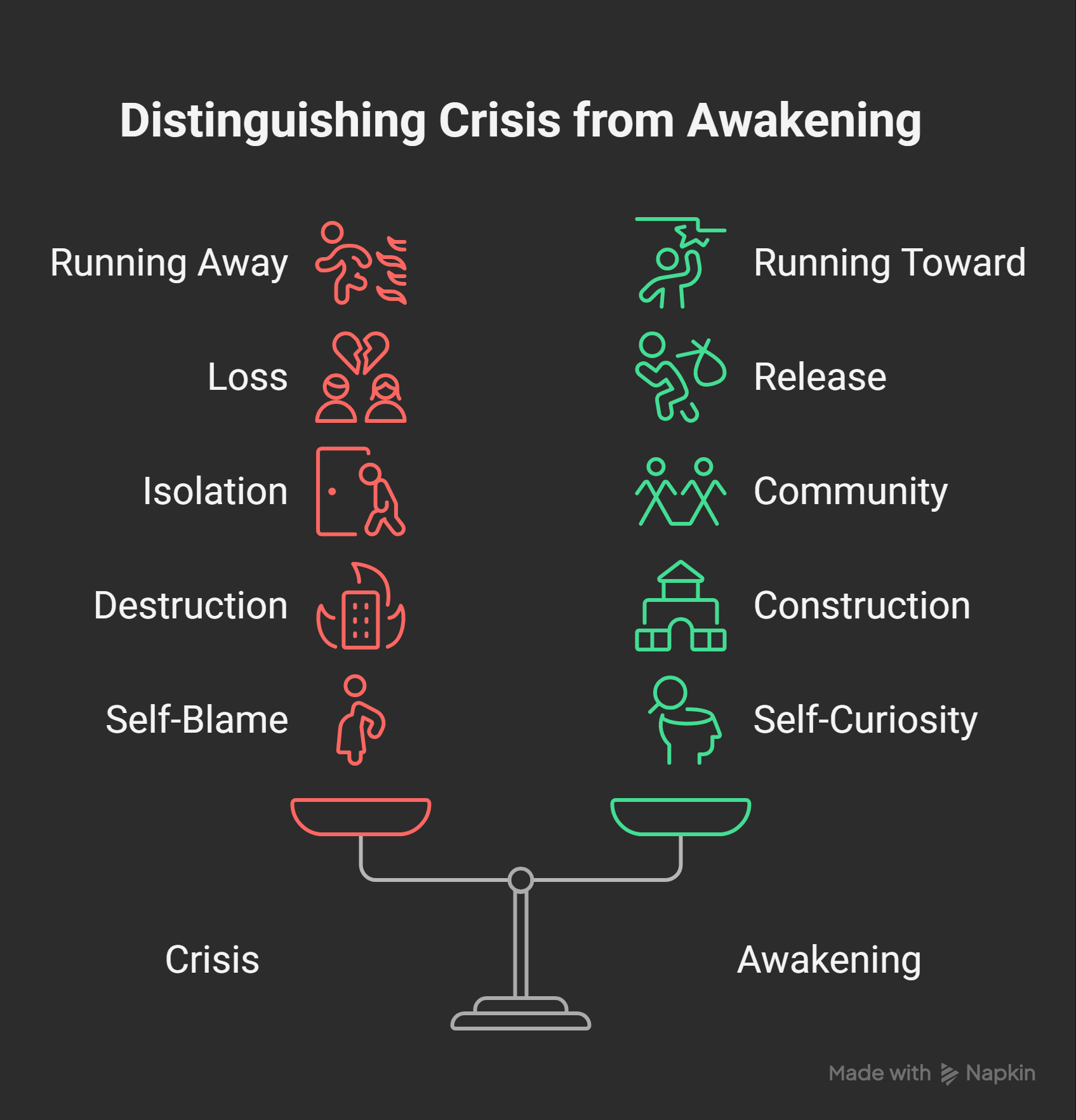
If you are still unsure whether you are experiencing a crisis or an awakening, these five questions will help you locate yourself. Take them seriously. Sit with them. Let them work on you.
1. Am I running away from something or toward something? Crisis runs away. Awakening runs toward. If you feel driven by fear of what you might miss or lose, you may be in crisis. However, if you feel pulled by curiosity about who you could become, you may be awakening.
2. Does this feel like loss or release? Crisis leaves you feeling like something is being taken away. Awakening feels like something you were never meant to carry is finally being set down. The sensation is similar, but the emotional signature is different.
3. Am I ashamed of this or energised by it? Crisis isolates you in secrecy. Awakening makes you want to find others who are also waking up. If you feel a pull toward community rather than toward hiding, that is a powerful sign.
4. Do I want to blow up my life or rebuild within it? Crisis is destructive and impulsive. Awakening is constructive and intentional. One says “burn it all down.” The other says “what stays, what goes, and what have I not yet built?”
5. Am I asking what is wrong with me or what is true for me? This is the most important question. Crisis makes you the problem. Awakening makes the life you outgrew the problem. The shift from self-blame to self-curiosity is the moment an awakening begins.
When You Are Ready to Go Deeper
These questions are the kind of work we do at Threshold Las Vegas, the three-day retreat I lead for twelve women at The Retreat on Charleston Peak. It is an intimate space designed for exactly this conversation. If you feel ready to stop wondering and start answering, it may be the right next step for you.
Frequently Asked Questions (FAQs)
What are the signs of a midlife crisis in a woman?
Common signs include a persistent sense of restlessness or dissatisfaction with a life that looks good on paper. Women experiencing this may notice sudden changes in their appearance or routine. They might question major life decisions like career or marriage. Emotional volatility that feels disproportionate to the circumstances is also common, along with a recurring sense of feeling trapped or longing for escape. These signs are real, but depending on how they are interpreted, they may point to awakening rather than crisis.
What are the six stages of a midlife crisis?
The six stages often associated with a midlife crisis begin with denial, in which a woman minimises her dissatisfaction. Next comes anger, as frustration surfaces at herself or her circumstances. Then replay occurs, when she revisits past decisions and imagines alternate paths. Depression follows, as the emotional weight settles. Withdrawal comes next, when she pulls back from relationships and routines. Finally, acceptance or reinvention emerges, as the new shape of her life begins to form. Notably, not every woman moves through all six, and the stages are not always linear.
What is a midlife awakening?
A midlife awakening is an intentional psychological and emotional shift in which a woman moves from living for others to living from her own centre. Unlike a crisis, which is reactive and disorienting, an awakening brings clarity, curiosity, and a growing sense of purpose. It does not feel like falling apart. Instead, it feels like coming together, often for the first time. It is not a breakdown of the self, it is a breakthrough of the self that was always there.
Does every woman go through a midlife crisis?
No. The idea that every woman will experience a midlife crisis is a cultural myth, not a developmental certainty. Many women navigate midlife with a sense of deepening rather than disruption. Some experience a quiet awakening without any dramatic rupture. Others experience both crisis and awakening at different moments. Ultimately, there is no single map for this terrain, and the absence of crisis does not mean the absence of growth.
This is the part of the post where I get to speak directly to you, no framework, no outline, just one woman to another. I spent years trying to fix something I thought was broken in me. I chased answers outside myself, read every book, asked every expert, tried every system. What I eventually discovered was not a solution to a problem. It was a willingness to stay in the question long enough for the answer to arrive on its own.
This season you are in, the one that feels uncertain and unravelling, is not a detour from your life. It is your life, asking you to live it more fully. You are not having a crisis. You are having a conversation with yourself that has been waiting to happen for a very long time. Stay in it. It will take you where you need to go. Make it a great day.
Register for Threshold Las Vegas
An intimate three-day retreat for women at The Charleston Peak, Kyle Canyon, Nevada.
This is where women in midlife transformation come to name what is waking up inside them.
Register Here
Make it a great day.