If you have been feeling like something is shifting inside you but you cannot quite name it, you may be wondering whether you are experiencing a midlife transition vs midlife crisis. I want to offer you a reframe that could change everything about how you navigate this season. The difference between a midlife transition and a midlife crisis is not just semantic. It is the difference between feeling like your life is falling apart and feeling like your life is rearranging itself into something more true. And the way you name what is happening to you determines how you move through it.
I remember sitting across from a client named Sarah in my Las Vegas coaching practice. At fifty-two years old, she was successful by every external measure yet deeply unhappy. She had come to me afraid she was having a midlife crisis. After reading all the articles and the memes, she felt like a cliche. But as we talked, something became clear. Sarah was not falling apart. She was outgrowing a life that had fit her in her thirties but no longer fit the woman she had become. The restlessness she felt was not a symptom of crisis. It was the first signal that a midlife transition had already begun.
You are not having a midlife crisis. You are crossing a threshold you cannot see yet. The confusion you feel is not a malfunction. It is the disorientation that comes before any realignment. Every woman I have worked with who thought she was in crisis was actually in the early stages of a transition that would ultimately make her more herself, not less. The difference is not in what you feel but in how you interpret it. A crisis says something is wrong with you. A transition says something is ready to be born.
What Is a Midlife Transition?
A midlife transition is a developmental stage, not a psychological breakdown. It is a natural period of reassessment that typically occurs between the ages of forty and sixty-five, during which you begin to evaluate the structure of your life and ask deeper questions about meaning, purpose, and fulfillment. Unlike a crisis, which is reactive and often destabilizing, a transition is an intentional or semi-intentional process of moving from one life stage to another. It involves letting go of identities and roles that no longer serve you, while gradually stepping into a more authentic version of yourself.
The concept of a midlife transition has been explored by thinkers like David Brooks in his book The Second Mountain. Brooks describes how the first half of life is often about building, achieving, and meeting external expectations. The second half, he argues, is about meaning, contribution, and living from a deeper center. This is not a crisis. It is a reordering of priorities that only becomes possible once you have climbed your first mountain and realized there is more to life than the view from the top. If you have not read The Second Mountain yet, I highly recommend it as a companion for this season of your life.
In my coaching practice, I see midlife transitions show up in three distinct phases. First comes the stirring, a quiet sense that something is off even though nothing is technically wrong. Then comes the unraveling, the period where old structures begin to loosen. And finally comes the rebuilding, where you consciously choose what stays, what goes, and what you want to create next. Each phase has its own challenges, but none of them are pathological. They are developmental, which means they are leading somewhere.
If you want to go deeper into what this kind of coaching looks like, I wrote about it in my post on midlife coaching for women, where I talk about how intentional support during this season can make the difference between feeling lost and finding your way.
What Is a Midlife Crisis?
A midlife crisis, by contrast, is a term popularized in the 1960s by psychologist Elliott Jaques. He was studying male executives confronting mortality and career ceilings, and the term was never designed to describe women’s experience at midlife. A midlife crisis is typically characterized by a sudden and often impulsive attempt to escape one’s life. It involves dramatic changes driven by fear rather than intention. Think of the stereotypical sports car, the abrupt career change with no plan, the sudden pursuit of a younger partner. These are attempts to outrun the discomfort of aging and lost relevance.
The problem with the term “midlife crisis” is that it pathologizes a natural developmental process. It turns a normal season of questioning into something you need to fix or medicate or power through. For women especially, the label of crisis can be deeply invalidating. When a woman in her forties or fifties starts asking hard questions about her marriage, her career, her identity, and her purpose, the world rushes to label it a crisis rather than honoring it as an awakening. The difference is important, and I wrote about it in detail in my first blog post on the midlife awakening.
Not every difficult season at midlife is a crisis. In fact, very few are. What looks like a crisis from the outside is often a transition happening without a roadmap, without support, and without the language to describe it. When you do not know you are in a transition, the discomfort feels like a crisis. When you name it as a transition, the same discomfort becomes a signal that growth is underway.
The Key Differences Between a Midlife Transition and a Midlife Crisis
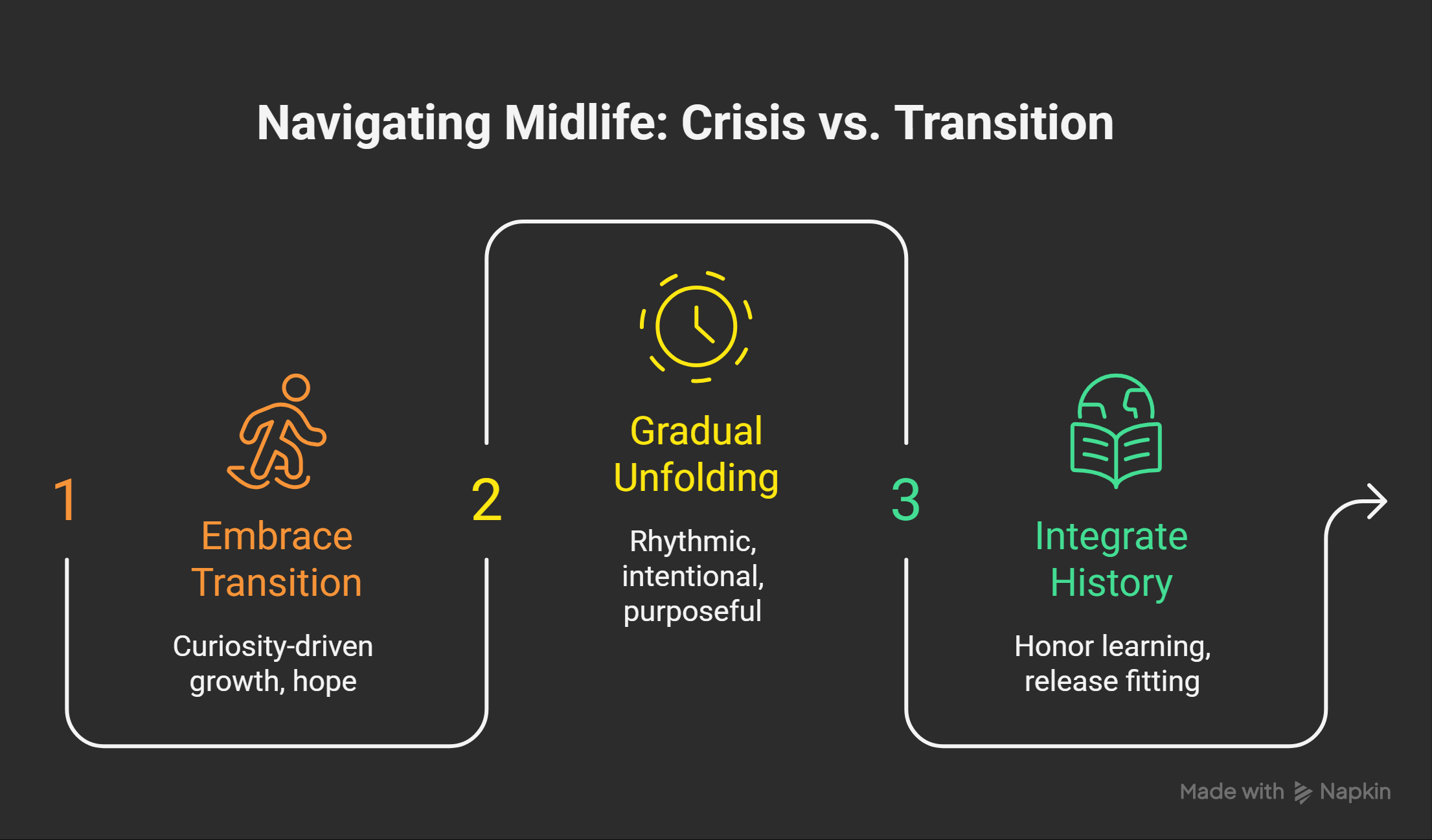
Understanding the difference between a midlife transition vs midlife crisis comes down to a few key distinctions. Let me lay them out clearly so you can locate yourself in this terrain.
Direction. A crisis runs away from something. It is driven by fear, panic, and a desire to escape. A transition runs toward something. It is driven by curiosity, hope, and a vision for who you are becoming. If you feel pulled forward rather than pushed out, you are in transition.
Pace. A crisis tends to be sudden and impulsive. It feels like an emergency. A transition unfolds gradually. It has a rhythm. There are periods of intensity and periods of stillness. You do not have to solve everything at once, and in fact, you should not try to.
Internal experience. A crisis feels like something is wrong with you. You feel broken, defective, ashamed. A transition feels like something is shifting inside you. It is uncomfortable, yes, but there is an underlying sense that this discomfort has meaning. It is not random — it is purposeful.
Relationship to the past. In a crisis, you want to escape your history. You want to burn it all down and start over. In a transition, you want to integrate your history. You want to honor what you have learned while releasing what no longer fits. The goal is not destruction but transformation.
Outcome. A crisis, if left unaddressed, often leads to regret. The impulsive decisions made during a crisis tend to create more problems than they solve. A transition, navigated with intention and support, leads to greater authenticity, deeper relationships, and a stronger sense of purpose.
Sam Baker, the founder of The Shift, wrote a powerful piece called “Forget Midlife Crisis, This Is a Midlife Transition” that describes exactly what I see in my coaching practice every day. I encourage you to read it as a companion to this post.
How to Navigate Your Midlife Transition with Intention
If you have recognized yourself in the description of a midlife transition rather than a crisis, here is how to move through it with grace and purpose.
Name what is happening. The single most powerful thing you can do is give your experience a name that empowers rather than pathologizes. Instead of saying “I am having a midlife crisis,” say “I am in a midlife transition.” This shift in language changes how your brain processes the experience. It moves you from victim to participant, from patient to explorer.
Find support. You were never meant to navigate this season alone. Whether it is a coach, a therapist, a trusted friend, or a community of women on the same path, you need people who can hold space for your questions without rushing to fix you. Midlife transition is not a problem to be solved. It is a process to be accompanied.
Get still. The noise of daily life will drown out the signals your inner self is sending. What you truly need is silence, space, and time away from the roles and responsibilities that have defined you long enough to hear what your own voice sounds like. This is why retreats like Threshold Las Vegas exist, to give women the gift of uninterrupted attention to their own becoming.
Ask better questions. Instead of asking “What is wrong with me?” ask “What is trying to emerge?” Instead of “How do I fix this?” ask “What wants my attention?” Instead of “Who should I be?” ask “Who am I becoming?” The questions you ask determine the answers you find.
Take one step at a time. A midlife transition does not require you to have a ten-year plan. It asks you to take the next right step, even if that step is as simple as saying no to something that drains you or yes to something that scares you. Small steps, taken consistently, will carry you across the threshold.
Why This Distinction Matters for Your 40s and 50s
The frame you use to understand your experience shapes your entire experience. If you believe you are in crisis, you will look for quick fixes and dramatic escapes. You will feel ashamed of what you are feeling. You will try to suppress the discomfort rather than listen to it. And you will likely emerge from this season having made changes that do not actually address the deeper questions your soul was asking.
If you understand that you are in a midlife transition, everything changes. Approach the discomfort with curiosity instead of fear. Give yourself permission to be in process and seek support instead of isolation. You emerge from this season not just intact but transformed, more aligned with your true self than you have ever been.
This is why I do the work I do. This is why I created Threshold Las Vegas, an intimate three-day retreat for twelve women at The Retreat on Charleston Peak in Kyle Canyon, Nevada. I have seen too many women suffer through what they thought was a crisis when they were really on the verge of a breakthrough. My mission is to help as many women as possible make this distinction early enough to navigate their midlife transition with intention, courage, and support.
The 40s and 50s are not a decline. They are an ascent into the most authentic version of yourself. The question is not whether you will change during these decades. The question is whether you will change reactively, in crisis mode, or intentionally, in transition mode. One leaves you with regret. The other leaves you with a life that finally feels like your own.
Frequently Asked Questions
What is the difference between a midlife transition and a midlife crisis?
A midlife transition is a natural developmental stage of reassessment and growth that occurs between the ages of forty and sixty-five. It involves questioning old structures and moving toward a more authentic self. A midlife crisis, by contrast, is a reactive and often impulsive response to the discomfort of aging, characterized by fear-driven decisions and attempts to escape rather than transform. The key difference lies in direction: transition moves you toward something meaningful, while crisis pushes you away from discomfort.
What are the signs of a midlife transition?
Common signs include a persistent sense that something is shifting even though nothing is obviously wrong, increased questioning of life choices and priorities, a desire for more meaning and purpose, restlessness that feels purposeful rather than panicked, curiosity about who you might become, and a gradual letting go of roles and identities that no longer fit. Unlike a crisis, these signs develop over time rather than appearing suddenly.
How long does a midlife transition last?
A midlife transition typically lasts between two and five years, though the timeline varies for each woman. The duration depends on factors including your willingness to sit with discomfort, the quality of support you have, and how consciously you engage with the process. Some women move through it more quickly with intentional coaching or therapy, while others take longer when they resist the changes that are calling to them.
Can a midlife transition lead to personal growth?
Absolutely. A midlife transition, when navigated with intention and support, is one of the most powerful periods of personal growth a woman can experience. It is a time when you shed what no longer serves you and step into greater authenticity, purpose, and self-awareness. Women who embrace their midlife transition often report feeling more alive, more confident, and more aligned with their true selves than at any previous point in their lives.
This is the part where I get to speak directly to you, no frameworks or outlines, just one woman to another. I spent years of my own life trying to fix something I thought was broken in me. I chased answers outside myself, read every book, asked every expert, and tried every system. What I eventually discovered was not a solution to a problem but a willingness to stay in the question long enough for the answer to arrive on its own. The season you are in right now, the one that feels uncertain and unravelling, is not a detour from your life. It is your life, asking you to live it more fully. You are not in crisis. You are in transition. And transition, when you surrender to it, takes you exactly where you need to go.
Make it a great day.
Cross the Threshold in Las Vegas
An intimate three-day retreat for 12 women at The Retreat on Charleston Peak, Kyle Canyon, Nevada. This is where women in midlife transformation come to name what is waking up inside them.